


Rocket objective:
The purpose of the IGNIS -1 Rocket, is mainly meant for research purposes on rocket science basics. The rocket will help the development of the UP – Projectile by teaching us how the rocket behaves in different conditions and how to fix them. The main reason this rocket was built, is to test different fuel compositions, propulsion, flight stability, launch methods, launch pad, ignition methods, material resistance to aerodynamic forces, parts manufacturing, thrust, rocket design, rocket balance, and many other related subjects.
Rocket Design:
The rocket is designed to be printed as fast as possible and without many parts. To determine how the rocket had to be designed, in terms of measurements, center of gravity and center of pressure OpenRocket simulator was used to make iterations until the designed was capable of flying, meaning that it was stable in flight according to the position of the center of mass and center of gravity.
The rocket includes a GPS at the top, for recovery. It also carries a death mass of 80g on the nose cone to provide a better stability coefficient, in this case 2.07.
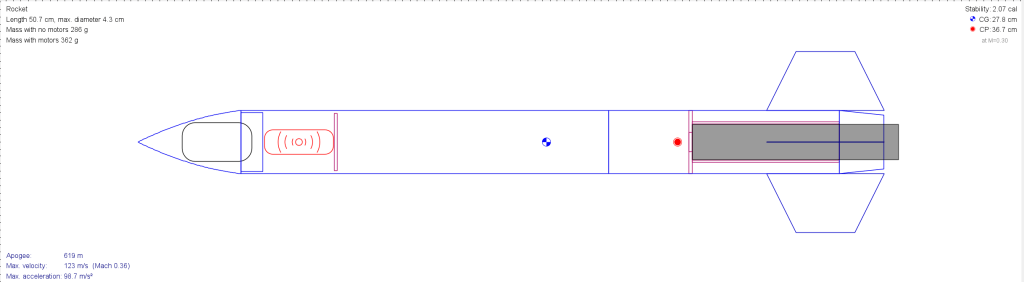
Requirements Definition:
STELLA IGNIS PROGRAM wanted to test different rocket fuel configurations after having done 5 static fire tests which can be viewed in IGNIS-1 Static fire tests, where we analyze each fire test and iterate depending on the things that failed. STELLA IGNIS achieved a successful static fire, where we registered a maximum thrust of 2.44348 Kg of thrust, as shown in Graph 1.1. After a successful static fire and being able to create an SRB that didn’t explode, the program wanted to do flight test. For that we developed IGNIS-1. The rocket requirements were defined by the program thinking on the best way to learn how to fly a rocket.
Requirements:
- Small, easy to manufacture rocket that can carry a small SRB, with different combustion chamber shapes
- Rocket must be easily assembled using nuts and bults
- The rocket must reach a minimum altitude of about 300 m
- The rocket must have a compatible launch pad that doesn’t damage or light on fire the ground below it.
- Rocket Manufacturing must take less than 10 hours
- Rocket must not explode in flight
- Rocket mus resist Max-Q and SRB temperature
- Rocket must weight less than 1 Kg
- In order to fly, the rocket must survive two static fire tests.
Mission Process:
Ignis one is meant to test different parameters and provide experience to the stella ignis program. The process shown is the one followed to perform this test and gain experience:

Design Concepts:
The main concepts consulted for the creation of this rocket rely mainly on physics and chemistry.
Aerodynamics:
Bernoulli: Bernoulli’s principle, states that a fluid’s pressure will be determined as it follows: Higher pressure means less speed, likewise, higher velocity results in a lower pressure. This principle is used to explain how planes flight generating lift, by creating a higher pressure below the wings and thus a lower pressure on top of the wing. As pressure flows from high to low, the wing generates a force upwards called lift. It’s important to note that Bernoulli’s principle is based in Newtonian fluids which are non-compressible fluids.
Reynolds Number: Reynolds number determines if whether a flow is laminar or turbulent.
Wing Tip Vortexes: Wing tip vortexes are created due to the pressure difference between the top and bottom sides of a wing. Basically, as pressure flows from high to low, right on the wing’s tip, the air has the possibility to escape, either the bottom or top side of the wing and travel to the opposite side, resulting in a circular motion which creates vortexes.
Boundary Layer: We are aware that while the fluid flows through a surface a boundary layer is created. The boundary layer determines where the flow will stop trying to stick to the surface. In other words, the closer the fluid is to the surface, the more it will try to stick to it (Skin Friction Drag). However, in the higher areas of the boundary layer, flow can be turbulent and create vortexes.
Rocket Basic Physiscs:
For the creation of the rocket we considered the position of the center of mass, and the center of pressure. These have to be separated having the center of pressure behind or below the center of mass, depending on the viewpoint. The greater the distance between these two and the closer the center of mass is to the center of the rocket, the better stability it will have. All of these, is because, the rocket will rotate around the center of gravity, and aerodynamic forces, such as lift, downforce and drag will be happening in the center of pressure. We want the center of pressure to be as close as possible to the rocket fins which are the once producing, the lift and downforce and will provide stabilization for the rocket.
CM & CP (Center of Mass & Center of Pressure)
The rocket was designed considering the fact that it will rotate using the center of mass as axis, whilst some forces like weight will happen at this center. Likewise, the design considers the fact that thrust and aerodynamic forces will act on the center of pressure.
Propulsion:
Every rocket is propelled based on the same principle, newton’s 3rd law of motion. The law states that for every applied force there will be an equal opposite force applied. This concept is also known as action-reaction. IGNIS-1 will be propelled base on this principle, just as any other rocket will. The rocket motor propels fuel molecules at incredibly high speeds, this is the action, thus there will be a reaction force acting on the rocket, and lifting it up.
IGNIS-1, will have a SRB (Solid Rocket Booster), as the engine. SRB, are as the name says, composed of a solid propellant, which is a mixture of an oxidizer and a fuel. In this case, we will be using Sugar as our fuel and KNO3 (Potassium nitrate) as the oxidizer. These two, have to be crush until we have a very fine grain, sugar glass is recommended for this type of SRB. After trituration, both of the fuel are mixed together, having 36% Sugar and 64%. This have to be thoroughly mixed and shacked together in a flask. After that, we place the first plug of the SRB and then a rod that will create the combustion chamber, this rod will have different shapes. The the fuel is carefully and strongly compressed inside the PVC tube. Finally the last plug is added and the SRB is ready to fire. For optimum performance the fuel must not wet or in contact with humidity.
DANGER CAUTION: After the fuel is mixed it should avoid any contact with heat, as it could easily ignite and wont be extinguished until it runs out. That is why, the fuel is stored in a vacuum and left in a heat isolated environment.
Lorem ipsum dolor sit amet, consectetur adipiscing elit. Ut elit tellus, luctus nec ullamcorper mattis, pulvinar dapibus leo.